When “your uncle” is still on the board
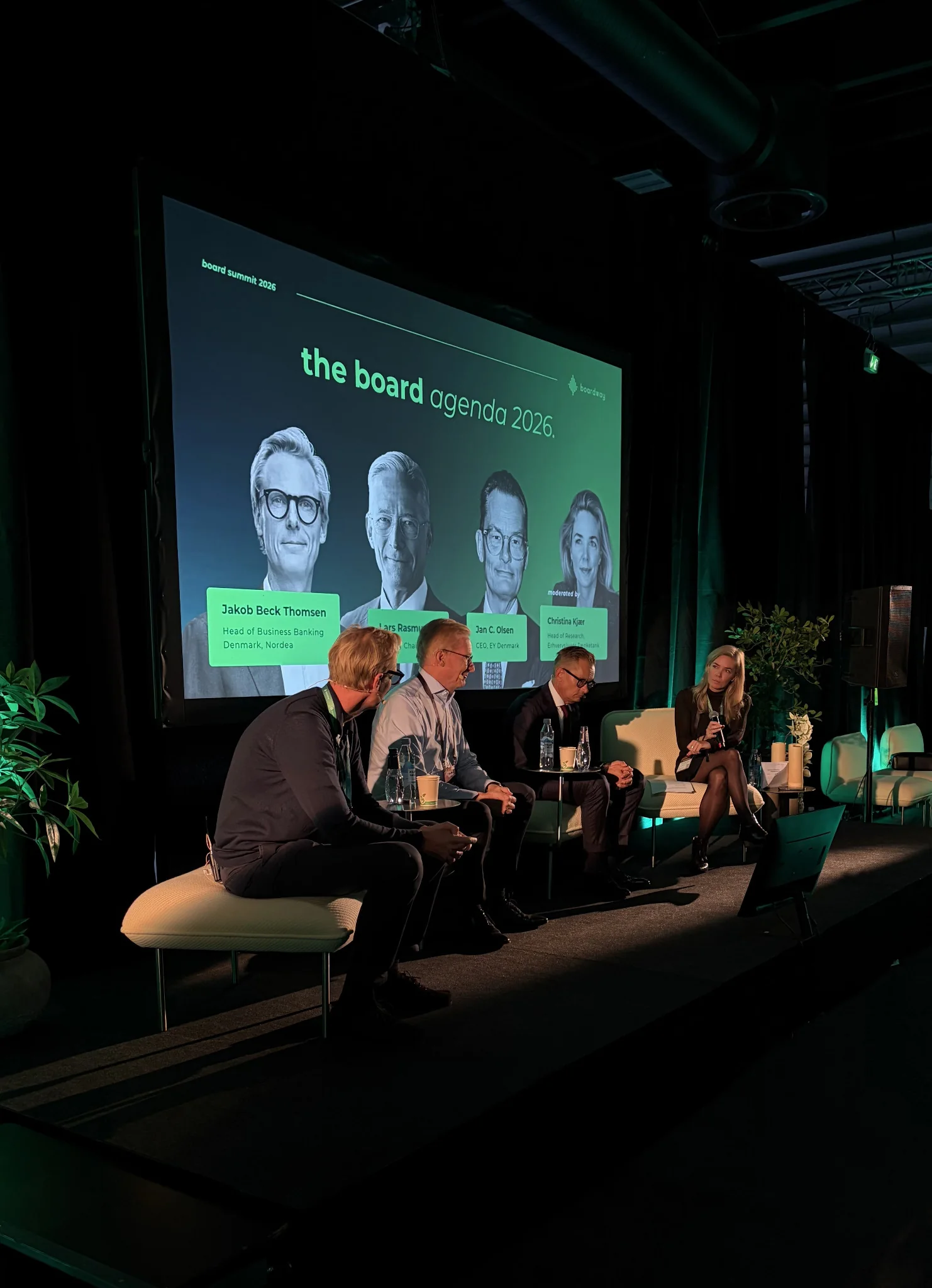
Jacob Beck Thomsen, Lars Rasmussen and Jan C. Olsen, on why having a board isn’t the same as having governance — and why closing the gap with the US and China may come down to who’s actually in the room, and whether companies are willing to rethink who sits there and for how long.
How confident should a bank be in the boards of Danish companies? At The Board Agenda, the panel discussed a surprisingly common challenge: Too many smaller companies still have boards made up of “the local lawyer or your uncle.”
The discussion, moderated by Christina Kjær and featuring Jacob Beck Thomsen, Lars Rasmussen and Jan C. Olsen, focused on what boards need to get right in an increasingly competitive and fast-moving world.
Europe risks falling behind
The panel discussed the growing competitive pressure from the US and China, while Europe risks falling behind in growth, investment and execution. For Danish companies, the challenge is not simply to protect their existing position, but to decide where they want to compete — and how quickly they need to move.
Having a board is not enough
The discussion also turned to the quality of boards, particularly in smaller and mid-sized companies. Having a board is not enough. Companies need the right people around the table, with the expertise and perspectives needed to challenge management and drive the right discussions.
While Denmark’s largest companies are becoming more agile and investing heavily, many smaller companies face greater constraints. At the same time, significant opportunities remain in areas such as electrification, defence and infrastructure — making strong governance increasingly important.
The innovation gap
Innovation and risk appetite were recurring themes throughout the discussion. The panel explored how Danish and Nordic companies can struggle to access sufficient growth capital, with startups sometimes looking to the US for funding and opportunities.
At the same time, Denmark’s current top companies are relatively mature, with too few new businesses emerging to become the giants of tomorrow. Staying competitive therefore requires the willingness to invest, innovate and take calculated risks.
Rethinking the board
The changing business environment may also call for a different approach to board composition. The panel discussed whether long board tenures still make sense in a world where companies’ needs and technologies are changing rapidly.
Rather than relying on the same expertise for years, companies could benefit from bringing in specialised knowledge for shorter periods — for example, adding AI expertise when it becomes strategically relevant and rotating it as the company’s needs evolve.